
Easter Day 31 March 2013
Acts 10: 34-43, Psalm 118: 1 - 2, 14 - 24, 1 Cor 15:19-26, John 20:1-18
A New Creation
"They found the stone rolled away from the tomb", and what exactly did that reveal? We can tell our children in Sunday School that it reveals that Christ is risen, he is resurrected and once more walks again in the garden. It is a simple understanding that "Eden" has been restored. However, if we only focus on Jesus on the first Easter morning, and only go as far as a literal reading of the events as narrated in the gospel then we too remain in the infancy of a Sunday-School world.
Contrary to popular misuse, the gospels are not there to tell us about Jesus; they serve a much richer purpose. They serve to illuminate what Christ reveals about us, and our place in the wholeness of creation. "They found the stone rolled away from the tomb", to reveal a new order, to illuminate a deeper appreciation of being and so too "A New Creation".
If we leave Easter as only an event located in history then it has little consequence for today and even less consequence for tomorrow. Easter becomes an event-anniversary rather than a revelation, an enlightenment of a new creation and an illustration of a new way of being and a new understanding of who we are.
"They found the stone rolled away from the tomb" And the Divine truth of creator and creation was revealed.
The image used on the front cover of the service sheet is a delightful illustration of what was (and is) revealed to us through the process of Easter and gives a contemporary insight into what Christ sought to reveal. So let's leave the Easter narrative and explore the image.
A few guesses usually centre on this being a view of the world. But the more closely you look the harder it is to reconcile with the world as we know it. And that's the first insight we might contemplate. Is there another view of the world, something beyond our own familiar knowing? The empty tomb of Easter suggests there is, for the Easter narrative goes beyond our normal, experiential expectations of life and death.
Here is an extract of the article that accompanied this image 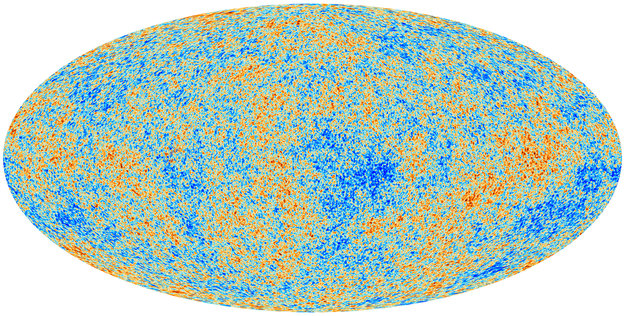
that was in the news last week... "The most detailed map ever made of the oldest light to shine through the universe has been released by scientists at the European Space Agency (ESA)." Plank reveals an almost Perfect Universe
The view of the heavens in red and blue speckles confirms with astonishing accuracy the theories cosmologists draw on to explain the evolution of the universe from a fraction of a second after the big bang.
The map reveals tiny variations in the "cosmic microwave background" or CMB – the faint glow of radiation that is left over from the earliest light to illuminate the cosmos. These primordial photons are all around us, and account for 1% of the "snow" that could be seen on untuned television sets.
The red and blue spots reveal areas where the CMB is slightly hotter or cooler than the average temperature of -270 Celsius. Regions that are cooler (blue) are more dense and later become the seeds of stars and clusters of galaxies.
Scientists compiled the map from more than 15 months of observations by the ESA's Planck telescope."
In John's gospel chapter 8:12, Jesus says: "I am the light of the world. Whoever follows me will never walk in darkness but will have the light of life." The image (like the empty tomb) reveals, "the earliest light to illuminate the cosmos" and "the oldest light to shine through the universe": the alpha and the omega. The "light of life" from the beginning of time continues to be present with us; we can even see it on our "untuned televisions".
"The latest data suggests the universe is expanding at a slower rate than thought, making it roughly 80m years older at 13.82bn years". Now that's not eternity but a light that has been shining for 13.82 billion years already goes beyond the imagination of the disciples, and most likely exceeds our own capacity to understand.
The data that is creative of this image reveals further knowledge about our universe, and the article goes on the say: "Scientists have made minor changes to the estimated makeup of the observable universe too, with normal matter now comprising slightly more, at 4.9%. There is a little more dark matter, at 26.8%, and less dark energy, at 68.3%. The results are described in 30 papers freely available online.
In the latter cases, "dark" is synonymous with "unknown". Dark matter is an invisible substance that appears to cling to galaxies, but whose existence can be inferred only by its gravitational pull. Dark energy is equally mysterious, and thought to drive the expansion of the universe."
The "observable universe" is only 4.9% of the universe - all that we see and understand and know is but 4.9% of what there actually is! The empty tomb invites us to contemplate the unknown and the unseen. It invites us beyond what we know, and beyond who we are into a much fuller abundance, and so into "A New Creation"
Our faith, our hope and our belief, our deepest desires and our becoming are somehow validated in this image. Likewise the empty tomb and the whole process of Easter are brought into a contemporary focus, enabling us to read the scriptures with a maturity that goes beyond the infancy of Sunday-school. This Easter morning we can delight with the same excitement that was voiced by George Efstathiou, a Planck scientist at Cambridge University when he saw this image: "Our ultimate goal would be to construct a new model that predicts the anomalies and links them together. But these are early days. So far, we don't know whether this is possible and what type of new physics might be needed. And that's exciting,"
This Easter morning he captures what it means to roll away the stone, to see an ultimate goal that is beyond all that we have known or seen before, and that opens us into a new creation that embraces the other 95.1% of life, and the other 95.1% of who we actually are. And he speaks of participating in the whole process, of constructing and linking together that which will realise the ultimate goal.
As church, we have the same quest.
"The director-general of Europe's space agency, Jean-Jacques Dordain, described the new map as "a giant leap in understanding the origins of the universe". And so he too describes the Easter event and the reality of where we are this Easter morning having rolled the stone away. To encounter resurrection asks of us a new understanding. and orientates us toward "A New Creation".
Here we have a giant leap in our understanding of Genesis, and so too of our creator and of ourselves as creature. The symbol of Genesis, the tree in the Garden with the Word from the serpent twisted in the tree is also the icon of Easter with the Word of God twisted on the cross. Both are icons of beginning - and herald "A New Creation". The movement of Genesis requires a movement out of the Garden (out from the Divine) into the world. The movement of Easter requires a movement into the garden (out from the Tomb) and again into the world.
The world of Genesis is the world of 4.9% and that is where we begin to discover ourselves, the Genesis of our being; with the apple from the tree of knowledge (a gift from the serpent) our eyes were opened and we saw all that was to be seen, sent out from the garden we discovered creation for ourselves. This is also the world confined by the knowing of birth and death, and that makes it a small world and a fearful place..
Now on Easter morning, we eat a different fruit, from the tree of the cross. A new Genesis, birthed from the womb when the stone is rolled away. And that action, or process, "the rolling away of the stone" opened the possibility of a new creation another 95.1% [by current best estimates] more than we currently see or imagine.
To picture this "giant leap in understanding" another way; if we use a car to represent ourselves (humanity), then our 4.9% understanding would have us fully aware of ourselves as a tyre. We know what we are, what we are made of and capable of and we know our purpose -we go round and round until we wear out! But we do not see or even imagine the car, for in our 4.9% knowing we are only aware of ourselves as a tyre and that is the whole of our universe. However, that all changes when we discover that we are actually part of something much more. No longer are we a tyre; we are part of a car. No longer do we go round and round: we travel, make journeys and carry people. You could say we discover that we really are going places. This Easter, we can roll the stone away and discover so much more, and become so much more.
Another quote from the article on the 'Plank Map' - "the oldest light to shine through the universe": "As that ancient light travels to us, matter acts like an obstacle course getting in its way and changing the patterns slightly," When we remove the obstacles, the light shines through unchanging, as it was in the beginning; when the stone is rolled away Genesis is restored. And Christ in the Easter narrative illustrates for us the process of realising our fullness of being, and so too the fullness of creation, not just the visible 4.9%.
Christ died on the cross. He offered himself into the wholeness of life, he gave himself and opened himself to "A New Creation". He realised, and so reveals to us, that our small "s" self is not the most important thing in the world. But in giving away, in giving all of ourselves, we are open to discover a bigger ["S"] that is a part of something divine, a universe that is permeated by "the oldest light to shine through the universe".
The tyre gives up its self-importance, it gives up being a tyre and discovers itself as part of a car, and integral to the very being a car.
Over and over again we have heard that "it is in giving that we receive"; that truth resounds at all levels. We give ourselves into our family, that is the genesis of the process, and we give into our community thereby realising even more of ourselves. These are, however, all activities within the 4.9% world order, the seen that is confined by birth and death. Easter asks us to give more, to give ourselves fully into the realisation of creation.
The orthodox emphasis of Easter does not look beyond our 4.9% world. But the very activity of Easter speaks of "A New Creation", a process of removing the obstacles, the matter that is getting in the way of "the oldest light to shine through the universe". The activity of Easter asks us to give ourselves to the discovery and participation of a life that is permeated with Divine light.
The change in the world, and in humanity when we discovered that the earth was not flat, but a sphere, was enormous. This Easter morning we are invited to roll away the stone, and to see something that is even more significant.
Will we give ourselves into the realisation of "A new creation"? Will we realise that the most important thing we can see on television is when the set is untuned? Will we find ourselves permeated by "the oldest light to shine through the universe".
Peter Humphris


